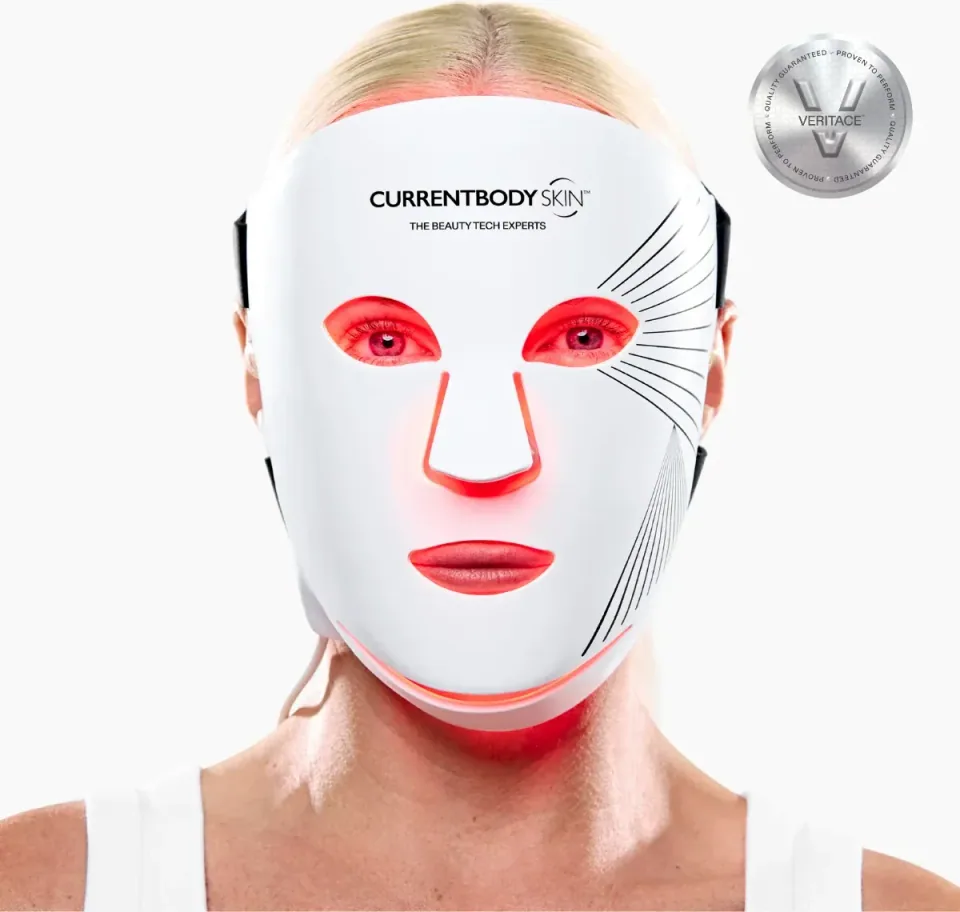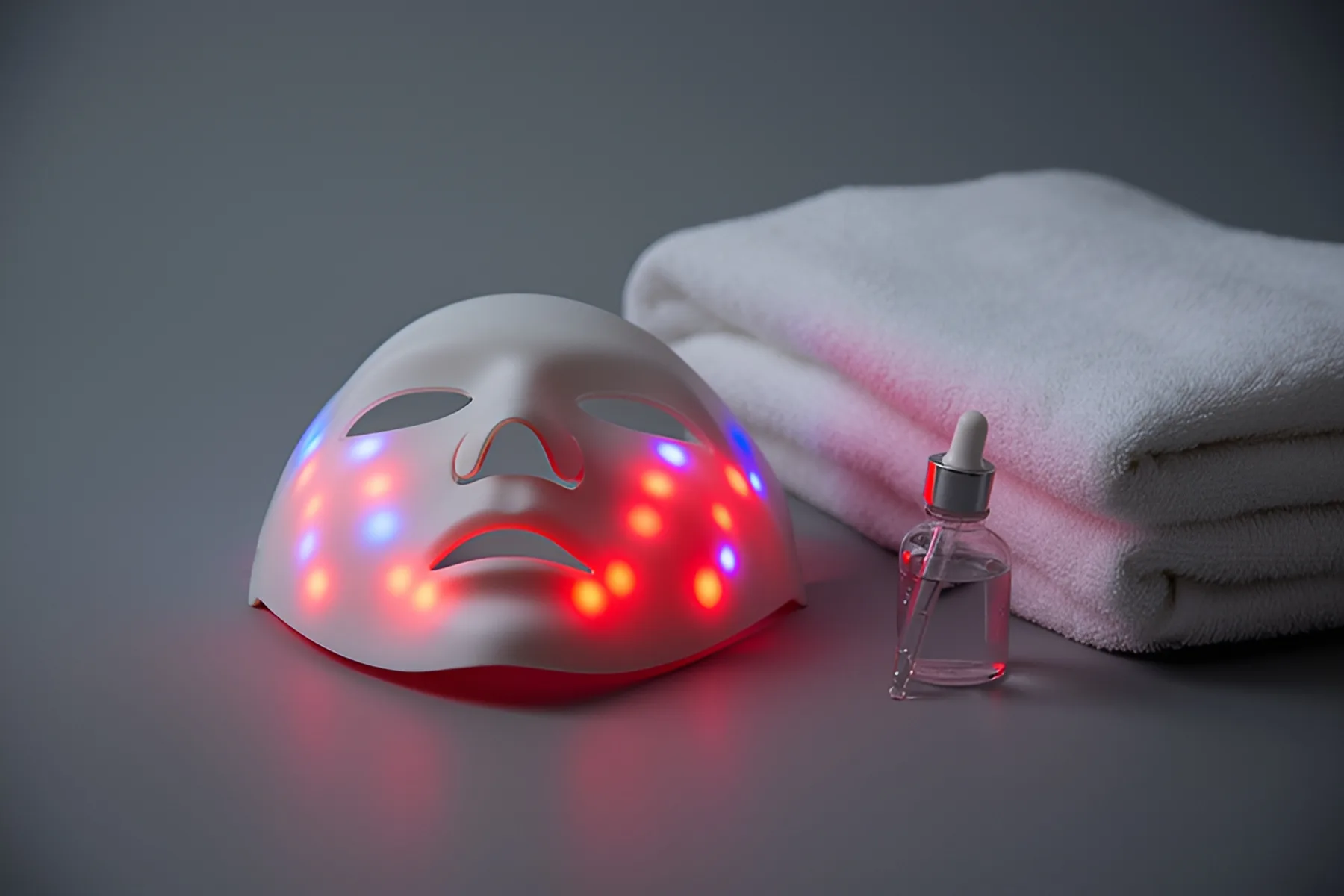
LED face masks have moved from dermatology offices to bathroom shelves, and from niche gadgets to some of the most-watched videos in beauty. The glowing red mask is easy to film, and the promises are appealing: firmer skin, fewer lines, calmer breakouts, no downtime.
The underlying science is real but more modest than the marketing. Here's what the trials show, how to read "FDA-cleared," and how to use a mask safely.
How LED light therapy is supposed to work
LED masks shine low-level light of specific colors onto the skin. Unlike lasers or ultraviolet light, they aren't meant to heat, burn or tan the skin. The American Academy of Dermatology (AAD) describes red and near-infrared light therapy, also called photobiomodulation, as a non-invasive treatment that some dermatologists use for acne, signs of aging and hair loss [1].
Different wavelengths are used for different jobs:
| Light | Wavelengths used in key studies | Main claimed use | Evidence strength |
|---|---|---|---|
| Red | 633 nm; 611–650 nm [5][6] | Fine lines, texture, tone | Modest, from small trials |
| Near-infrared (invisible) | 830 nm [5] | Firmness, collagen | Modest, often combined with red |
| Blue | Short end of the visible spectrum | Pimples | Limited; mixed results [2][7] |
Many masks combine colors, and brands often add others such as amber or green. Those extra colors have far less research behind them.
The evidence for red and near-infrared light
The trials
Two controlled trials are cited again and again.
Lee and colleagues, 2007 (Korea). In this randomized, double-blind, split-face study, 76 people with facial wrinkles had half of their face treated twice a week for four weeks. They received 830 nm, 633 nm, both, or a sham light [5]. All three active groups showed objectively measured wrinkle reductions of up to 36% and gains in skin elasticity of up to 19% compared with baseline. Skin samples showed more collagen and elastic fibers, and no adverse effects were reported [5].
Wunsch and Matuschka, 2014 (Germany). In this randomized, controlled study, 113 of 136 volunteers were treated twice a week for 30 sessions with either red light (611–650 nm) or a broader red-to-near-infrared spectrum (570–850 nm). The remaining 23 served as controls [6]. Treated subjects showed improved complexion, smoother skin on profilometry and higher collagen density on ultrasound, confirmed by blinded photo assessment. The broader spectrum showed no advantage over red light alone [6].
Both used clinic-grade light sources, not consumer masks, and both measured results over weeks to a few months.
The bigger picture
A 2018 systematic review of 31 randomized controlled trials of LED therapy in dermatology gave its strongest grade (B) to only a few uses: acne, herpes simplex and zoster, and acute wound healing. Other skin uses, including cosmetic ones, received grades C or D [4]. The reviewers flagged recurring weaknesses: small samples (often fewer than 20 people), missing blinding, no sham control and inconsistent treatment settings [4].
The AAD summarizes the cosmetic evidence this way: red LED devices can produce "subtle to noticeable" results for fine lines, dark spots, rough texture, redness and loose skin. Because studies use different devices, durations and outcomes, it's difficult to know how effective at-home devices are, and more research is needed [1]. Open questions include how long red light can safely be used, the best number of treatments and the right dose for home use [1].
Bottom line: Red and near-infrared LED light has real, if modest, evidence for smoother texture and fine lines. Expect gradual, subtle change, not a facelift.
The evidence for blue light and acne
Blue light is marketed for breakouts. According to the AAD, visible light devices, whether blue, red or blue plus red, can treat pimples. They aren't effective against blackheads, whiteheads, cysts or nodules [2]. Home devices are less powerful than a dermatologist's, some require 30 to 60 minutes twice a day for four to five weeks, and there's no way to know in advance who will respond [2].
The research base is large but weak. A 2016 Cochrane review included 71 studies with 4,211 participants. Most studies were small, with a median of 31 people, and two-thirds were industry-sponsored. The reviewers concluded that high-quality evidence on light therapies for acne is lacking [7]. A 2022 systematic review of home-based devices was more positive. It recommended LEDs for acne at home and found favorable safety, while noting few randomized trials and little long-term data [8].
For acne that leaves marks, keeps recurring or is painful, a board-certified dermatologist can offer treatments with much stronger evidence. Our guides to chemical exfoliants and retinoids for beginners cover over-the-counter options.
What "FDA-cleared" means, and doesn't
Many masks carry an "FDA-cleared" badge, and it's often misread.
- Cleared, not approved. Most of these devices reach the US market through a 510(k) premarket notification. The maker shows that the device is substantially equivalent to a legally marketed device, meaning it has the same intended use and either the same technology or different technology that doesn't raise new safety and effectiveness questions. The FDA's resulting order "clears" the device for sale [3].
- It's about risk, not results. The AAD explains that "FDA-cleared" means the FDA considers the device low risk, and that clearance "doesn't tell you anything about how effective the device is" [1].
- "FDA-approved" or "FDA-certified" are red flags. According to the AAD, those terms have no meaning when used to describe a medical device, since the FDA clears these devices rather than approving or certifying them [1].
- Clearance is for a specific use. A device cleared for wrinkles isn't automatically cleared for acne, and the reverse. The AAD suggests choosing a device made for the concern you want to treat [1].
At-home vs. in-office
| At-home mask | Dermatologist's office | |
|---|---|---|
| Power | Lower [1][2] | Higher [1] |
| Typical role | Maintenance or a mild stand-alone treatment | Often one part of a plan with topicals, peels or microneedling [1] |
| Commitment | Frequent sessions over weeks, then ongoing | Scheduled series |
| Cost | Roughly $100 to more than $1,000 per device [1] | Per session |
| Supervision | None | Clinician selects settings and screens for risks |
The AAD notes that dermatologists typically use red light as a complementary therapy and may recommend a home device to maintain results after in-office treatment [1].
Safety
LED light isn't ultraviolet. The AAD notes that research hasn't found that red light causes any type of cancer. It appears safe in the short term, with mild, temporary pain or irritation as the most common side effects [1]. Long-term effects on skin and hair aren't yet known [1].
Eyes. The bright light shines close to the eyes, so follow the instructions exactly. The AAD advises wearing eye protection whenever a device's directions call for it, using the recommended goggles rather than sunglasses [1]. In 2019 Neutrogena recalled its Light Therapy Acne Mask over a "theoretical risk" of eye injury. The company said the risk applied to a small subset of users with certain eye conditions or taking medications that increase the eyes' sensitivity to light. It described reported vision effects as rare, generally mild and transient [9].
Who should check with a dermatologist first:
- People with darker skin tones. Darker skin is more sensitive to visible light, including red light, which can lead to hyperpigmentation that's more intense and longer-lasting [1].
- People with light-sensitive conditions, such as lupus [1].
- Anyone taking photosensitizing medication or undergoing other skin treatments [1].
- People with eye conditions, who should ask their eye doctor as well [9].
Watch out: Stop using a mask and contact a clinician if you notice eye discomfort, vision changes, or skin irritation or darkening that doesn't settle.
How to choose and use a mask
- Decide what you want it for. Texture and fine lines point to red and near-infrared; occasional pimples to blue or blue plus red [1][2].
- Look for FDA clearance for that use, listed on the box or in the device information as "FDA-cleared" or "FDA 510(k) cleared" [1].
- Check the specs. Reputable makers list wavelengths, and many list irradiance and session time. Vague "seven colors" claims with no numbers are a yellow flag.
- Plan for consistency. Results in trials came from repeated sessions over at least four weeks [5][6]. Set a routine you'll keep.
- Keep the foundations. Daily sunscreen and proven topicals do far more for aging and acne than any light device.
When we score skin devices, performance rests on published studies and hands-on reviewers. Build and usability cover comfort, fit, eye protection and battery life, and value compares cost against similarly specified rivals. Details are in how we score.
Bottom line: LED masks are a legitimate but modest tool. Red and near-infrared light have the better evidence for texture and fine lines, blue light's acne evidence is mixed, "FDA-cleared" speaks to safety rather than results, and consistency matters more than the brand.
Good questions.
Do LED face masks really work?
They can produce modest improvements for some people. Controlled trials of red and near-infrared light have measured smoother texture, fewer fine lines and more collagen, but most were small, short and done with clinic-strength devices. The AAD describes results as subtle to noticeable and says it's hard to know how effective specific at-home devices are. Think of a mask as a small add-on to sunscreen and proven topicals, not a replacement.
How often should I use an LED mask?
Follow the manufacturer's directions, which vary by device. Many clinical protocols used sessions two or more times a week for four weeks or longer, and at-home acne devices may need daily or twice-daily use for several weeks. Results fade if you stop, so plan for ongoing use. More time per session isn't automatically better.
Is an LED mask safe for my eyes?
The AAD considers LED devices safe for home use when used as directed, and advises wearing eye protection whenever the directions say to, using the protection recommended rather than sunglasses. In 2019 Neutrogena recalled its Light Therapy Acne Mask over a theoretical risk of eye injury for people with certain eye conditions or taking light-sensitizing medication. If you have an eye condition, ask your eye doctor before using one.
Can I use an LED mask with retinol or vitamin C?
Some medications and skin treatments make skin more sensitive to light, which is one reason the AAD recommends checking with a dermatologist first. Follow your device's directions on whether to apply skincare before or after a session. If you use prescription retinoids or other photosensitizing products, follow your dermatologist's guidance.
References
The research behind this guide — open any source to read the original.
- [1]Is red light therapy right for your skin? — American Academy of Dermatology
- [2]Lasers and lights: How well do they treat acne? — American Academy of Dermatology
- [3]Premarket Notification 510(k) — U.S. Food and Drug Administration
- [4]Light-emitting diodes in dermatology: A systematic review of randomized controlled trials — Lasers in Surgery and Medicine (2018), via PubMed
- [5]A prospective, randomized, placebo-controlled, double-blinded, and split-face clinical study on LED phototherapy for skin rejuvenation: clinical, profilometric, histologic, ultrastructural, and biochemical evaluations and comparison of three different treatment settings — Journal of Photochemistry and Photobiology B (2007), via PubMed
- [6]A controlled trial to determine the efficacy of red and near-infrared light treatment in patient satisfaction, reduction of fine lines, wrinkles, skin roughness, and intradermal collagen density increase — Photomedicine and Laser Surgery (2014), via PubMed
- [7]Light therapies for acne — Cochrane Database of Systematic Reviews (2016), via PubMed
- [8]Home-based devices in dermatology: a systematic review of safety and efficacy — Archives of Dermatological Research (2022), via PubMed
- [9]Eye injury risk prompts recall of Neutrogena light therapy acne mask — Association of Optometrists, Optometry Today (2019)
Educational content, not medical advice. Patch-test anything new, and see a dermatologist for persistent skin or scalp concerns. Our editorial standards
Discussion
What do you think?
No discussions yet.
Tried this article? Ask a question or share how it’s working for your skin or hair — you’ll be the first.